

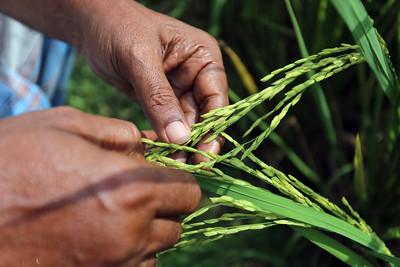
Global agriculture is already stretched by rising temperatures, erratic rainfall and soil degradation. Under current policies, the world is heading toward a 2.5 to 2.9°C rise by 2100 – conditions that will push many major crops beyond their physiological limits. To keep food production viable and within climate limits, we will need to use resources more efficiently, cut fossil fuels from farming, shift toward lower-carbon foods and manage land so it stores more carbon.
At the same time, we need to recognise that food demand is changing. By 2050, we won’t just need more food than today due to population growth, but the types of food will reflect – more than ever – the preferences of those living in urban areas and shifting nutritional priorities. Climate-linked volatility, already visible in coffee and cocoa prices, will further rewire trade flows.
Innovations in crop breeding are already helping us rise to the challenge. Advances in genomics, phenotyping and new breeding tools like CRISPR-based gene editing have reduced the time it takes to move new varieties from the lab to farmers’ fields – from decades to years. Scientists can now design plants with multiple stacked traits – like nitrogen use efficiency, pest resistance, specific taste profiles and micronutrient density – all in one genetic package.
Yet the benefits of genetic acceleration remain uneven. Three seed industry giants – Bayer, Syngenta and Corteva – account for over half of global seed sales. Meanwhile, most improved crops in low- and middle-income countries still come from public-sector breeding programmes with limited funding and patchy access to new technologies.
Frontiers of the future farm
Climate change creates both losses and opportunities. Some regions will become ‘transformation zones’ where current crops can no longer survive, and adaptive systems and crops must take their place. In the northern frontier boreal regions – the cold, forest zones mostly in Canada, Russia, Alaska and Scandinavia – may open to cereals but risk massive carbon release from thawing peat.
Desert and urban farming will depend on salt-tolerant crop varieties, vertical farming systems that grow crops in stacked layers (often indoors) and circular water use, which – for example – filter and reuse irrigation water. Mariculture – in the form of algae farming – holds promise as a source of food, fuel and livestock feed, but disease control in algae production remains a major obstacle.
Beyond the “big four” staple grains (rice, wheat, maize and soybean), “opportunity crops” such as finger millet, teff, taro, okra and amaranth could anchor more resilient, diversified diets. Improved varieties of bioenergy crops like miscanthus and switchgrass – both fast-growing, high-biomass, perennial grasses – could support the energy transition, while improved forages could cut methane emissions from livestock. Circular-economy breeding aims to design crops whose every part has a purpose: for example, roots for storing soil carbon, stalks for fibre, leaves for feed and residues for bioenergy production.
Target Traits of Future Crops
Target Traits of Future Crops
Breeders will seek to embody resilience, for example through:
- Adaptation to specific systems such as intercropping or agrivoltaics.
- Perennial and deep-rooted varieties that rebuild soils and store carbon.
- Nitrogen-fixing symbiotic crops that replace fertiliser.
- Enhanced photosynthesis for higher yields per photon.
- Biofortified staples rich in iron, zinc and omega-3 fatty acids.
The monoculture model – dominant in large-scale farming for decades – is giving way to mixed farming systems that combine crops and livestock, and which are more aligned with natural ecological processes. Future farms will combine trees with forage crops, crops with solar panels (agrivoltaics) and fish with vegetables (aquaponics). Carbon farming – managing land so that it acts as a carbon sink – can help farm landscapes deliver food, energy and ecosystem services at the same time.
More radical changes involve food production leaving the farm altogether. Microbial proteins, cultured plant cells and chemosynthetic fats produced in factories, not fields, could soon supply a significant slice of human nutrition. Even agriculture’s purpose is transforming – from measuring tonnes of food or feed per hectare to metrics that include its contribution to human health and biodiversity conservation per litre of water or per gram of carbon. It means the farms of the future won’t necessarily chase maximum output – but engineer balance.
The politics of plant power
That said, technological advances do not emerge in isolation, and their success will depend on a range of issues: intellectual-property rules, public trust in biotechnology, open access to gene-editing tools, fair benefit-sharing of genetic materials and data, and transparent communication about risks and rewards, to name a few. Governments, seed companies, NGOs and investors each have a role in building trust, funding discovery and ensuring that innovation benefits not just wealthy farmers and consumers, but everyone who eats and manages land.
With all this in mind, it is likely that agriculture’s next 30 years will be defined not by a top-down transformation but by a mosaic of smaller, interconnected solutions to feed a hotter, hungrier world and steward our collective ecosystems. Among these solutions, future crops could deliver not just more food, but smarter food systems.
Header photo credits: Nicole Jawerth/IAEA 2016